
College History

In 2012, St Catherine’s will celebrate its first half century as a college. We will be reflecting with great pride on the achievements of the past five decades, and looking forward to a future that sees Oxford’s youngest, and largest, undergraduate and graduate college continue to be recognised as an outstanding institution for learning, education and research in the arts and sciences. The fiftieth anniversary of the College’s foundation will also afford us with an opportunity to acknowledge the fact that the roots of the present-day College extend back into the nineteenth century: St Catherine’s College rests firmly upon foundations built by the students and academics who were members of the Delegacy or, later, St Catherine’s Society.


History and buildings


The Delegacy; St Catharine’s Club; St Catherine’s Society

The origin of today’s College was a ‘Delegacy’ (a non-collegiate organisation under the control of the University) founded in 1868 in order to provide access to an Oxford education for those who could not afford the costs of college membership. That mission is once again particularly relevant as we approach our 150th anniversary.

The Delegacy initially occupied one room at the top of the Clarendon Building in Broad Street. In 1871 it was granted the use of the Old Convocation House in St Mary’s for worship and special occasions. In 1875 Gladstone contributed 180 books towards its first library. All the students then had to live in lodgings - as some still choose to - principally off the Cowley and Iffley Roads or in Jericho. They rapidly banded together in quasi-collegiate fashion for social and sporting purposes. A debate took place in 1869; music and history societies and a magazine followed. Colours – French grey, maroon, chocolate -  were established by the Boat Club, its first boat having appeared on the river in 1876. From 1874 the hub of this extra curricular activity was the St Catharine’s [sic] Club, named from the eponymous Hall at the end of Broad Street where it met (now absorbed into Hertford College). The name continued to be spelled in promiscuous fashion until 1919 when the Club agreed that St Catherine’s was to be preferred (perhaps to distinguish it from St Catharine’s in Cambridge). The Club was officially recognised by the University as the St Catherine’s Society in 1931.

A statue of Einstein in the SCR garden.

Meanwhile the Delegacy had progressed to two rooms in the newly built Examination Schools (only available in Michaelmas and Hilary Terms); thence to more satisfactory quarters at 74 High Street, and in 1936, after many abortive bids for expansion, to a new building (now the Music Faculty) designed by Sir Hubert Worthington on land in St Aldate’s sold by Christ Church. Two notably distinguished Masters of Balliol, Benjamin Jowett in the 1880s and AD Lindsay in the 1930s, were particularly helpful in furthering these changes.

In 1930 the Revd V J K Brook was appointed Censor (Head) and remained so for twenty-one years doing much to consolidate the position of the Society. The nineteenth-century origins of the Society had developed particular bonds of fraternity between its members, who were inclined to be more active on its behalf than alumni of other colleges. Alumni had been meeting to dine together since 1895, in the 1920’s they formed the St Catherine’s Association, led by RM Montgomery, a distinguished KC. In taking on the responsibility for bringing ranges of alumni together, this body was unique at that date and provided a model which colleges only very gradually followed in the latter part of the twentieth century.

By the end of Brook’s Censorship it was evident that the role of the Society had become somewhat anomalous in the post war world. The passage of the Education Act in 1944 coupled with the post-war introduction of grants, guaranteeing financial support for any student accepted by the University, made the original purpose of the old Delegacy less distinct. The Society had become more like a College, and colleges in their turn had become more like the Society in admitting candidates from a wider range of socio-economic backgrounds. It was time for a new focus, and the appointment to the Censorship of the historian, Alan Bullock (later Lord Bullock of Leafield), in 1952, provided exactly that.


Alan Bullock and the Creation of the College

Alan BullockIn 1952, the year in which his book Hitler: A Study in Tyranny was published, Alan Bullock was appointed Censor (Head) of St Catherine's Society. The permanent academic staff comprised Alan himself, and four Tutors, including Wilfrid Knapp and John Simopoulos. Alan could see that if it was to continue to develop and expand, the Society would have to change. In 1956 the Delegates took the momentous decision to transform the Society into a college. The University was persuaded to give its consent, and Alan Bullock began to look for a site and funding.


The site - part of Holywell Great Meadow - was acquired from Merton after complex negotiations in 1960. Nearly eight acres cost £57,690. The purchase was funded by the University Grants Committee (UGC) who also agreed to supply £250,000 towards the building, provided that the expenditure per study bedroom did not exceed £840 - a formula determined by costs elsewhere in the University sector. The resulting cuts to specifications inevitably led to far greater expenditure in future years. Further grants were to bring the UGC contribution to over £400,000 by the time the College was complete, but the formulaic approach remained a significant impediment, causing Alan Bullock to say, 'What I should really like is a building capable of being expanded or contracted according to need whenever a visiting Vice-Chancellor is in the neighbourhood.'

At the same time Alan Bullock had embarked on an unprecedented – as he thought - campaign to interest Industry and the City in funding the new College specifically as an agent for change which would work in their interest. It was a considerable blow to discover in March 1958 that Cambridge was about to launch a similar project in honour of a more topical patron: Sir Winston Churchill. These difficulties too were surmounted, and by 1960 Alan had raised a further £1,000,000 with invaluable assistance from two industrial notables, Sir Alan Wilson (met by chance on the Queen Mary) and Sir Hugh Beaver. It was then estimated that the complete project would require £2,300,000, including an endowment of £600,000. In mid 1961 the prospects of achieving this appeared bleak. Building costs, inevitably, had been under-estimated: there was talk of reducing the buildings and cutting the endowment by half. The position was rescued, serendipitously, by an American alumnus Dr Rudolph Light, who came from the family which had founded Upjohn Chemicals. John Simopoulos met him at dinner in 1957 and immediately perceived the warmth of his feelings towards the new College. Over the next 15 years, Light’s benefactions amounted to £1,600,000. Without them the College could never have achieved so much. By remarkable coincidence Mrs Light had previously been married to another old member, John Paul Getty I. Her grandson, Mark Getty, was fittingly to be Simopoulos’s pupil at the other end of his tutorial career.


The modern Development of St Catherine’s and its Buildings

Arne JacobsonAs befitted its pioneering origins, the new college was to be distinctive from the outset. One highly innovative decision was to admit equal numbers of science and arts students each year - recognising, ahead of many others, the vital role and fast-advancing world of science and technology. Much effort was spent in promoting the College to schools of all different types to attract the widest possible range of applicants. Even the buildings were to proclaim a new attitude, in keeping with the spirit of the 1960s and looking to modernism rather than the past. The appointment of the Danish architect Arne Jacobsen aroused controversy and was seen by many, mistakenly, as a tacit condemnation of the British profession. However, his striking modernist design, characterised by strong geometry, became one of the first five post-war buildings to be given Grade 1 listed status, and has matured to create a sophisticated and attractive environment.

When the College opened to its first students in October 1962, only a few buildings were ready for occupation and none of them were complete. The band of pioneers who endured the privations of that first term quickly became known as the 'Dirty Thirty'. However, by the end of the academic year 150 undergraduates had taken up residence. The College grew steadily. In 1974 it became one of the first five colleges in Oxford to become mixed and by 1978 was the largest college within the University.

There were to be three more waves of building after the first: the Jacobsen plan was finally completed with the Bernard Sunley building in 1968; In 1982 Jacobsen’s assistant Professor Knud Holscher added the Mary Sunley and Alan Bullock buildings at the northern edge of the main site. To make way for them, a pleasant row of Robinias outside the SCR under which Fellows parked the occasional car was replaced by a much larger car park to the north enclosed by magnificent beech hedges. This in turn began to be rearranged in 1992-95 when Stephen Hodder, then a relatively untried Manchester architect, was appointed to design 3 new staircases and two guest rooms alongside the river. Hodder went on to win the Stirling Prize, and Phase 2 of his scheme for St Catherine’s was completed in 2005 by the addition of six more staircases and the Arumugam Building containing a new Porter’s Lodge and seminar rooms.

The lodge and Staircase 22 as seen from the Merton Sports Fields


Why St Catherine?

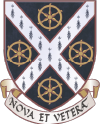
The club that became St Catherine's Society took its name from its original meeting place, St Catharine's Hall, a house in Broad Street now forming part of Hertford College. However the connection with the saint is is appropriate for a college founded on an ethos of high academic standards combined with a doggedly independent streak.

Catherine was one of many women carried off from Alexandria by the Emperor Maxentius in 305. Maxentius brought fifty philosophers to convince her that her belief in Christianity was foolish, but Catherine had studied in depth, and although aged only eighteen, confounded the arguments of the philosophers and ended up converting them. Maxentius had the philosophers put to death and Catherine imprisoned. However, when the Emperor's wife was also converted after visiting Catherine in prison, the Emperor decided that she had to die. A wheel set with razors was constructed and Catherine was tied to its rim, but instead of cutting her to pieces, the wheel broke and some of its splinters and razors injured the onlookers. Finally Catherine was beheaded.

The College celebrates its patron saint each year with a special Catz Night dinner, attended by junior and senior members of the College, at the end of which a giant Catherine wheel is lit in the quad.